

For the hunchback, the martyr, the heretic and the rebel, blasphemy has always been a powerful means for creative rebellion.
In her memoir ‘Bread of Angels’, Patti Smith keeps returning to something she calls her “rebel hump,” even if the meaning of this imagined flaw initially eludes her. She begins writing with the incantatory repetition “rebel hump rebel hump rebel hump,” before completely understanding what the words mean. The image gradually comes into focus as one of a “miniature Quasimodo” that she imagines trapped within the body of an awkward child being raised in a deeply religious household. As she traces the transformation of a perceived deformity into a benevolent internal companion, she eventually comes to recognise it as the rebellious spirit that would become inseparable from her creative identity.
Despite its distinctly autobiographical genealogy, Smith’s rebel hump was all I could think about while watching Vanessa Redgrave as the hunchbacked abbess of the 17th-century convent at the heart of the newly restored, uncut version of The Devils, Ken Russell’s 1971 take on Aldous Huxley’s novel ‘The Devils of Loudun’, which upon release, was subjected to extensive censorship because of its blasphemous fusion of sexual imagery, religious iconography and violence. Here, too, religious repression takes the form of a body that will not “behave”.
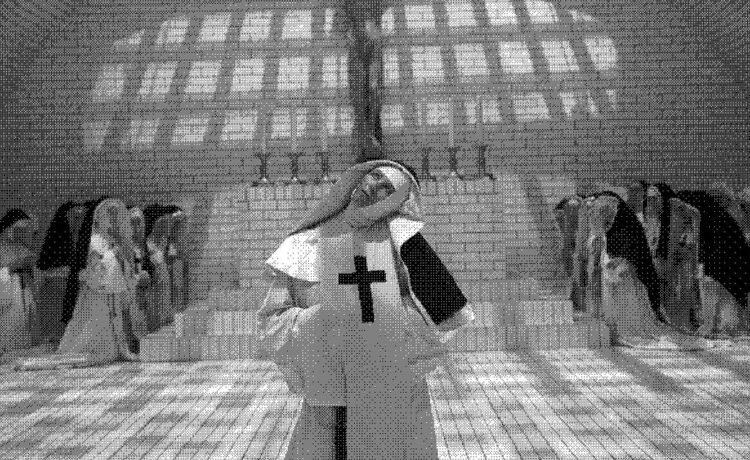
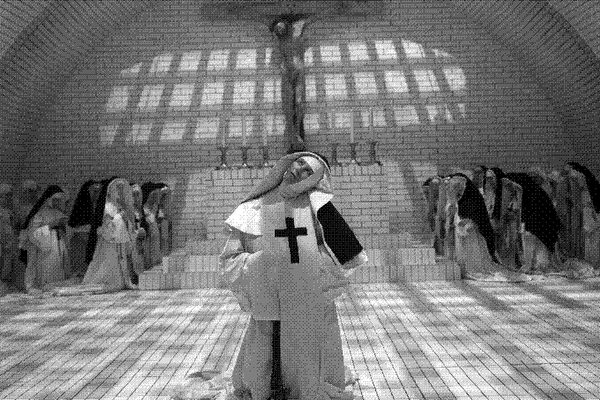
Redgrave’s Sister Jeanne is physically marked by her pronounced deformity: “Take away my hump!” she cries in agony, longing to be beautiful as her desire for the charismatic Father Grandier (Oliver Reed) erupts into sexual fantasies and vindictive jealousy. The historical Jeanne des Anges was at the centre of the alleged possessions at Loudun; Russell transforms this history as the nun’s body becomes the site onto which the film’s larger collision between Catholicism, eroticism and institutional power is mapped, her own “rebel hump” a metaphor for an excess of self that is visibly out of alignment with the rigid geometry of the convent – its religious habits, white walls and rectilinear spaces designed to discipline every possible expression of sexual appetite. When Jeanne peers through a grille at Grandier, her hunched body appears through a claustrophobic wide angle as an architectural obstruction, a protuberance of unruly flesh inside an institution devoted to making flesh disappear.
Indeed, the scenes that most alarmed censors at the time were precisely those in which the sacred became flesh, where religious iconography could no longer remain safely symbolic, where devotion became indistinguishable from lust, performance and bodily excess. This is where Derek Jarman’s artistic contribution becomes particularly significant. The Devils was his first feature film production design credit, marking an early encounter with a visual vocabulary he would continue to develop throughout his filmmaking career. His vision of Loudun was an anachronistically pristine, monumental city of geometric severity that drew on modernist and neoclassical architectural ideas as well as the stark visual worlds of Carl Theodor Dreyer and Fritz Lang.
Five years later, Jarman would take precisely this conflict between religious authority and unruly embodiment into his own debut feature, Sebastiane, which he co-directed with Paul Humfress and which celebrates its 50th anniversary this year. Where Russell turns Catholic imagery into an extravagant meditation on institutional power, sexual repression and religious hysteria, Jarman appropriates and radically abstracts it as a language for queer desire, persecution and survival – in this case through the figure of Saint Sebastian. The Christian martyr’s nude, bound body penetrated by arrows had already acquired a homoerotic charge through centuries of Western art; Jarman refuses to leave that charge at the level of subtext, elevating it to text, making homoeroticism not an illicit meaning beneath the image, but the image itself.
In the Sardinian landscape of Sebastiane, inhabited by largely naked Roman soldiers (famously, Jarman explained the nudity by saying the production “couldn’t afford costumes”), Leonardo Treviglio’s taciturn martyr refuses to reciprocate the advances of his lustful commanding officer Severus (Barney James), enduring torture without yielding or displaying any pain. His exposed body becomes an object that refuses correction altogether, unlike with Sister Jeanne, whose deformity is experienced as a humiliation from which she longs to be freed. This is perhaps the crucial shift from Russell to Jarman – the “rebel hump” is less a symbol of rebellion than a way to imagine what happens when the thing that’s supposed to be flattened, corrected, smoothed out, becomes the source of the work itself: unbeholden and unbound.