

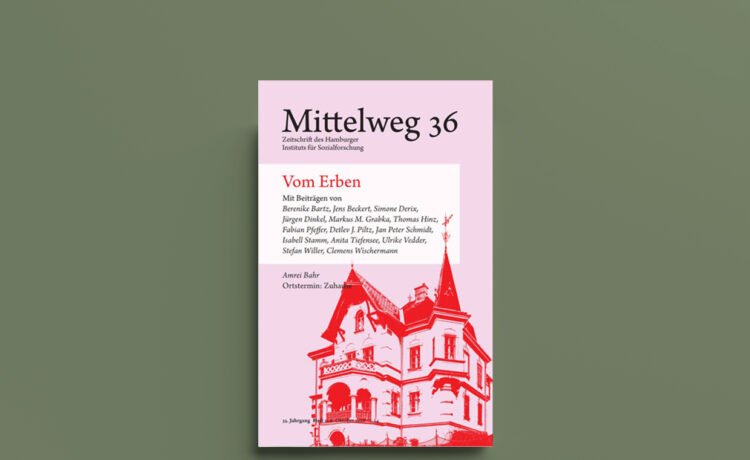
Mittelweg 36 turns to the practices and politics of ‘inheritance’, in which ‘material values are entangled with emotional values’, as historian Jürgen Dinkel notes in his editorial. The topic is thus uniquely suited to demonstrating that the personal is political. For inheritance is about far more than simply passing on property. Rather, it is the ‘negotiation of social relationships’ within and beyond the family.

The continuity of inheritance
Across historical periods and an array of political systems, the family has remained the key fulcrum of inheritance, writes Dinkel in a survey of inheritance law and practice in Europe and the US from the late-18th century until the present. The foundations for current inheritance law were laid throughout the 19th century, replacing the diversity of early-modern customs. The modern family can be said to be constituted by these laws and practices and has remained surprisingly resilient in the face of ensuing efforts by the state to restrict its freedom of choice in how to deal with its wealth.
Following the First World War, governments on both sides of the Atlantic increasingly attempted to use inheritance law to fill state coffers. The Nazis restricted inheritance to male successors, the Bolsheviks forbade passing on wealth per se, and the United States levied inheritance tax in order preclude revolution in an increasingly unequal society. From the 1960s, these interventions were largely scaled back, in part due to the refusal of citizens to give up deeply held beliefs about the family’s primacy when it comes to private wealth.
In Germany, wealth is distributed comparatively unequally, with half of all private wealth derived from inheritances and 50% of bequeathed wealth going to 10% of all heirs. Isabell Stamm and colleagues conducted a study on how affluent family dynasties work to keep their wealth in the family. She shows how inheritance in these families is not a one-time event taking place upon the passing of a family member, but an ongoing process carried out over the lifetimes of family members, who function as a community of heirs even before anyone has died.
Using tools such as endowments, foundations, and the distribution of shares in family-owned corporations, these families have created an ‘architecture of property’ with bureaucratic, legal, and entrepreneurial components, all of which aim at maintaining wealth and power. ‘Property competence’ is much more than financial or legal expertise, it is primarily a soft skill honed by family members who invest in relationships and prepare younger generations for their responsibility toward family wealth. This competence is key in making and maintaining class privilege and distinction and is articulated by the families – and their advisors – as ‘intergenerational resilience.’
The fragility of inheritance
Ulrike Vedder traces the continuity of legal and social inheritance norms from the 19th century through the present day. In Germany, a hand-written will signed by the testator is still the guarantor of its authenticity. The continuity of personal wealth beyond the threshold of death and the privileging of immediate family members in the succession are thus still at the core of how we think about and exercise inheritance.
However, Vedder finds this stability to be contested in literary treatments of inheritance. Novels and philosophical explorations of inheritance from the 19th century until today tease out and escalate the paradoxes underlying inheritance: how can a person’s will survive their passing? If the law privileges the children of the deceased over other potential beneficiaries, is it turning what should be freely given into forced obligation, rendering parents their children’s debtors?
Nineteenth-century novels tended to frame these questions as scenarios of conflict and refusal primarily between fathers and sons. Contemporary treatments, by contrast, broaden the concept of inheritance to include cultural heritage and the ‘burdensome legacy of war, Shoah, guilt and denial’. Characters inherit material goods freighted with an unclean history they would prefer to have nothing to do with, or they discover that they have genetically inherited trauma that plays out, for example, in their relationship to food (e.g. in Lügen über meine Mutter by Daniela Dröscher). Literature thus exposes as ever incomplete the attempts of law and social practices to stabilise complex human relations.
The contradictions of inheritance
Stefan Willer is interested in paradoxes such as the immediate coincidence of human loss and economic gain in the case of an inheritance, or that despite there never having been so much private wealth passed on, we are seeing the transformation of the basic institutions undergirding inheritance law: marriage, the family and reproduction.
Willer guides us through a close critical reading of three contemporary German-language texts that engage with these conundrums. Journalist Julia Friedrich’s book Wir Erben (‘We the heirs’) leverages a strong meritocratic critique of inheritance law and practices, which she considers unjust because they ensure that the children of the wealthy acquire wealth through no effort of their own. Swiss author Lukas Bärfuss in Vaters Kiste (‘Father’s box’) takes his inheritance of debt from his father as the occasion to think about the larger debt we as a society have inherited from our foreparents and would rather refuse: all the trash that is threatening to destroy us. Finally, Marlen Hobrack’s Erbgut (‘Genome’) also wrestles with an undesired inheritance: the useless objects hoarded by her mother, which function as psychoanalytic trailheads. Willer concludes that a necessary rethinking of inheritance can, is and should continue to be conducted in literary texts.
Review by Millay Hyatt