From “Recession Blonde: How Economic Uncertainty Spurred the Latest Hair Color Trend”, March 17th:
What is “recession blonde?”
Recession blonde (or recession brunette) refers to the darker, more brown-tinted hue that many are letting grow in with their normally bright, golden strands. TikTok users explain that while it may look like “old-money blonde,” letting their natural roots grow actually points to how the economy is affecting their spending habits; many are opting out of their touch-up appointments to save money.
While cost still depends on where you get your color done, upkeep for blonde hair can be quite the investment and oftentimes the more expensive option. “There are so many complexities to being blonde, and so many different methods to get to the end goal,” celebrity colorist Jenna Perry tells Vogue. “A double process, hyper blonde, is one of the most labor-intensive on your colorist to provide the biggest blonde impact. Highlights generally feel more natural, although the final may look effortless. A skilled application is akin to that of a trained painter and [cost] ranges depending on your colorist as well.”
…
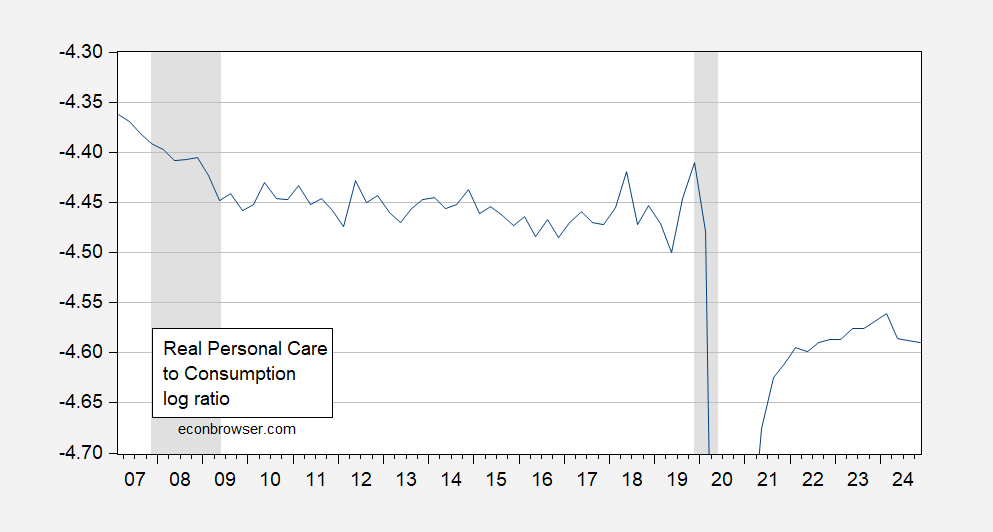
I personally have not noticed this trend, although that doesn’t mean much. I tried to find data on hair salon expenditures, but the closest I could get at fairly high frequency is the BEA’s “personal care and clothing services” category. I plot the log ratio of the real measure of personal care services to total real consumption (keeping in mind these are chained quantities).
Figure 1: Log ratio of personal care and clothing services to total consumption, in Ch.2017$ (blue). NBER defined peak-to-trough recession dates shaded gray. Source: BEA, and author’s calculations.
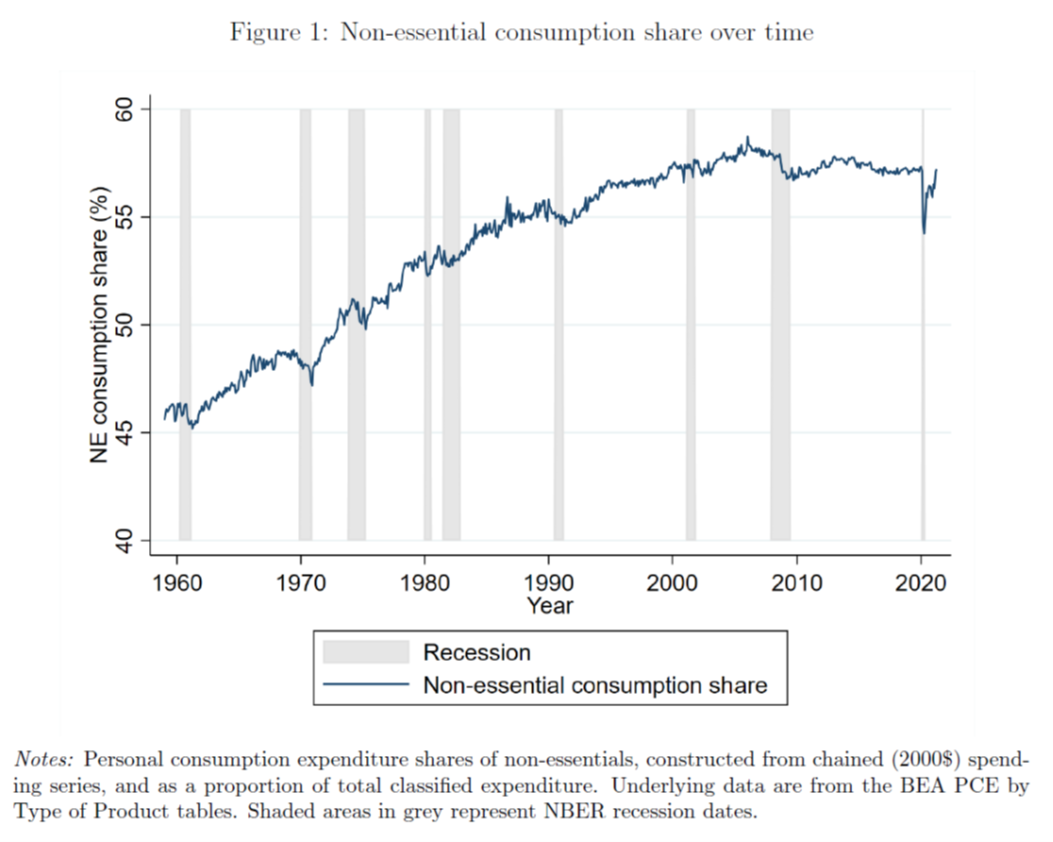
The recent peak is at 2024Q1, and has been declining since then (through 2024Q4). How reliable are such indicators? This real series goes back only to 2007Q1 at the quarterly frequency; however, as discussed in this post, Michele Andreolli, Natalie S. Rickard, and Paolo Surico have conducted a more formal analysis, in “Non-Essential Business Cycles”
From the abstract:
Using newly constructed time series of consumption, prices and earnings in essential and non-essential sectors, we document three main empirical regularities on post-WWII U.S. data: (i) spending on non-essentials is more sensitive to the business-cycle than spending on essentials; (ii) earnings in non-essential sectors are more cyclical than in essential sectors; (iii) low-earners are more likely to work in non-essential industries. We develop and estimate a structural model with non-homothetic preferences over two expenditure goods, hand-to-mouth consumers and heterogeneity in labour productivity that is consistent with these findings. We use the model to revisit the transmission of monetary policy and find that the interaction of cyclical product demand composition and cyclical labour demand composition greatly amplifies business-cycle fluctuations.
Here’s a key picture.
Source: Andreolli et al (2024).
See also Orchard (2024).
So, one thing to look at is Q1 consumption composition, as well as the level. A continued downward movement in “personal care and clothing services” might well signal an imminent downturn.
Get some extra life out of your unused SSDs by converting them into external storage…
Don’t sit on the sidelines during open enrollment. Source link
As of yesterday, from EIA via FRED: Source link
Tether holds about 150,000 bitcoin, worth some $11.5 billion at current prices, CEO Paolo Ardoino…
Nebraskans will vote on two ballot measures that can reshape the state’s gambling industry and…
Hello and welcome to Eye on AI. In this edition: AI is on the ballot.…